
Leakage current is a critical limiter of sensor performance, yield, and reliability. The leakage current is one of the few parameters that directly impacts both yield and product pricing.
Across a typical sensor portfolio, leakage reduction at BEOL can unlock $10–25M annual value.
In this case study, SisuSemi is introducing a new low‑temperature (200 °C) BEOL‑compatible Atomic‑Level Purification (ALP™) process that significantly reduces leakage current and variability without violating BEOL thermal budgets.
This BEOL process enables measurable yield recovery, average selling point (ASP) uplift, and reliability improvements across multiple sensor segments.
The Challenge: Leakage Current in Sensor Manufacturing
Leakage current originates from thermally generated carriers, introducing signal-independent noise and pixel-to-pixel variability that directly impacts sensor accuracy. The problems are visible across the semiconductor sensor landscape. The leakage current is causing:
- Increases electrical noise and degrades signal quality
- Raises power consumption and self‑heating
- Reduces long‑term reliability and device lifetime
For manufacturers, the impact is visible early:
- Test and calibration: higher leakage increases variability and calibration cost
- Yield and binning: leakage‑limited devices are downgraded or scrapped
- Final product quality: residual variability remains even after calibration
Because completed sensor structures are constrained by BEOL thermal budgets, traditional high‑temperature surface treatments are often not viable. This is where SisuSemi’s BEOL process ads value.
The Solution: Low‑Temperature (200 °C) BEOL ALP™ Process
SisuSemi has developed a BEOL‑compatible ALP™ process operating at temperatures as low as 200 °C, enabling leakage current reduction on finished sensor devices without risking metal diffusion or structural degradation.
This makes leakage reduction possible where it was previously inaccessible.
Before we look the results, we shall look how this translates to financial impact.
Business Drivers
The Leakage Current has a significant impact across the sensor segments. We have estimated the business impact through Yield-Driven Value and ASP uplift potential.
Yield‑Driven Value (Example Scenario)
Assumptions:
- Annual volume: 10 million sensors
- Current ASP: $2.5 per unit
- Base yield: ~90%
- Leakage‑related yield loss: 2–4%
- Conservative recovery: 75%
Result:
- Yield recovery: 2.25% (3% potential * 75% recovery)
- Saved units: 225 000 annually
- Direct revenue gain: ≈ $0.56M per year
ASP Uplift Potential
A ~50% reduction in leakage current enables re‑binning into higher‑value performance segments. No change in volume.
Example:
- ASP increase from $2.5 → $3.5, uplift +$1.5
- Volume: 10 million units
- Annual revenue upside: ≈ $15M
Estimated Annual Impact by Sensor Segment
Across sensor segments, over 80% of the total value is driven by ASP uplift rather than yield recovery, highlighting the strong link between performance and pricing.
| Sensor Segment | Annual Volume (M units) | Current ASP ($) | Est. Yield Drop from Leakage | Recovered Yield (%) | Annual Yield Gain ($M) | Est. ASP Shift ($) | Annual Market Gain ($M) | Annual Total Gain ($M) |
| CMOS Image Sensors (CIS) | 15 | 3.5 | 4 % | 3.00 % | 1.58 | 1.5 | 22.50 | 24.08 |
| Optical / ToF / LiDAR | 5 | 20 | 3 % | 2.25 % | 2.25 | 2 | 10.00 | 12.25 |
| Gas / Chemical Sensors | 5 | 15 | 3 % | 2.25 % | 1.69 | 1.5 | 7.50 | 9.19 |
| RF / IoT Sensors | 10 | 3 | 2 % | 1.50 % | 0.45 | 1 | 10.00 | 10.45 |
| MEMS (IMU, pressure) | 10 | 6 | 2 % | 1.50 % | 0.90 | 0.5 | 5.00 | 5.90 |
| Temperature Sensors | 5 | 2.5 | 1 % | 0.75 % | 0.09 | 0.3 | 1.50 | 1.59 |
Proven Process Outcomes at 200 °C
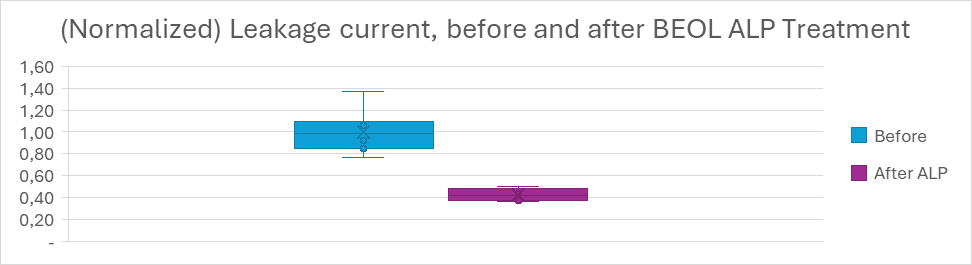
SisuSemi validated the low‑temperature ALP™ process using third‑party commercial sensor components.
Without design‑specific optimization, the following results were demonstrated:
| Process | Reduction in leakage current (Median) | Reduction variation (Stdev) |
| 200°C – BEOL solution | 58% | 72% |
In addition to a 58% median leakage reduction, a 72% reduction in variation (standard deviation) was observed, indicating significantly improved uniformity across devices, directly impacting yield, calibration effort, and final product consistency & performance.
Across a typical sensor portfolio, leakage reduction at BEOL can unlock $10–25M annual value per product line, with the majority driven by ASP uplift rather than yield recovery.
This positions leakage control not just as a process optimization, but as a direct revenue expansion lever.
Why Low Temperature Matters
The key advantage of the 200 °C ALP™ process is that it enables leakage reduction after BEOL completion, where conventional solutions, using higher temperatures, are no longer viable.
This unlocks performance improvement without redesign, material changes, or front-end process disruption, significantly lowering adoption barriers.
Your Opportunity
Validate 200 °C BEOL‑compatible leakage reduction and performance improvement on your own sensor components using post‑dicing ALP™ treatment. Initial validation is fast, low risk, and low cost, providing a clear and measurable path to quantify yield improvement, performance gain, and revenue impact on your own products.
About SisuSemi
SisuSemi commercializes decades of academic research into atomic‑level surface and interface purification. Its ALP™ systems support component‑level and wafer‑level treatment up to 300 mm, improving interfaces by removing atomic‑scale defects (e.g., oxygen, hydrogen, carbon), recovering atomic order, and protecting surfaces with thin crystalline SiO₂.
 Share
Share
 Tweet
Tweet
 Share
Share
 Share
Share