
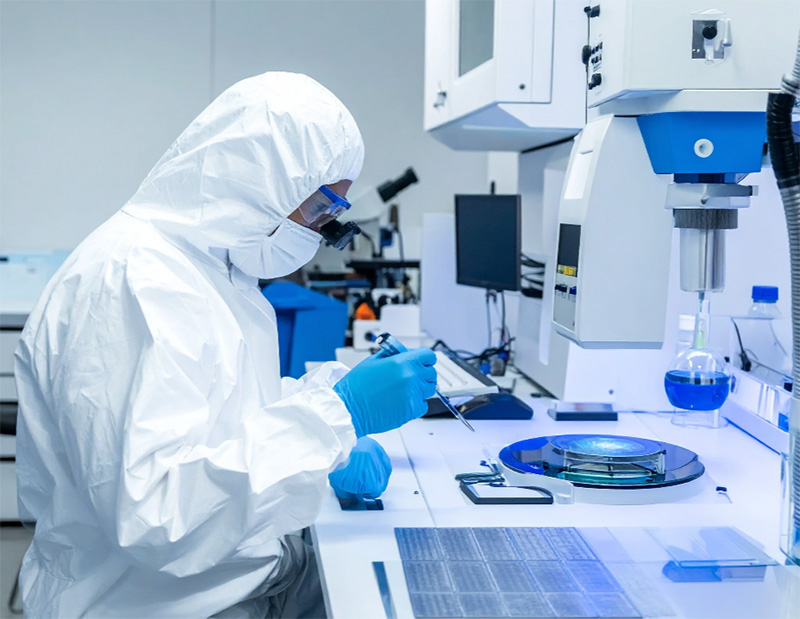
In today’s advanced semiconductor manufacturing, reducing defect density defines the difference between average and world-class yield performance. SisuSemi’s atomic-level approach helps to eliminate microscopic impurities that lead to costly defects.
In the relentless pursuit of Moore’s Law and beyond, semiconductor business development teams face increasingly complex decisions about technology investments. While much attention focuses on lithography advances and novel architectures, one critical factor often remains hidden in the technical details: atomic-level impurities at semiconductor interfaces—a key enabler of reducing defect density. Understanding these microscopic defects is essential for making informed strategic decisions that can determine the success or failure of multi-billion-dollar technology roadmaps.
The hidden challenge: What are atomic-level impurities?
Atomic-level impurities are foreign atoms or structural defects that occur at the interfaces between different materials in semiconductor devices. These impurities exist at concentrations as low as parts per billion but can dramatically impact device performance. Common examples include oxygen and carbon atoms at silicon-dielectric interfaces, metal contaminants from processing equipment, dangling bonds where crystal structures don’t perfectly align and charge traps created by incomplete atomic bonding.
Think of these impurities as microscopic potholes on an otherwise smooth highway. Even a few can disrupt the flow of electrons, leading to cascading effects on device performance.
Impact on semiconductor performance and quality
Performance degradation
Atomic-level impurities directly affect the fundamental properties that determine semiconductor performance:
- Carrier mobility: IImpurities scatter electrons and holes, reducing their mobility through the semiconductor. This translates to slower switching speeds and reduced frequency response in high-performance processors and RF devices.
- Threshold voltage variation: Interface impurities cause device-to-device variations in threshold voltages, leading to timing uncertainties and requiring larger design margins. This directly impacts the maximum achievable clock frequencies.
- Reliability issues: Impurities can create hot spots for degradation mechanisms like hot carrier injection and time-dependent dielectric breakdown, reducing device lifetime and increasing failure rates.
QUALITY IMPLICATIONS AND REDUCING DEFECT DENSITY
From a quality perspective, interface impurities manifest as increased defect density leading to higher test escape rates and parametric yield loss, where devices function, but don’t meet specifications. Furthermore, they cause reduced process window making manufacturing more sensitive to variations and field reliability issues that emerge after devices are deployed. Therefore, reducing defect density becomes essential to maintain device consistency and prevent costly failures in the field.
Power consumption consequences
Interface impurities have profound implications for power consumption, a critical concern in today’s energy-conscious market:
- Leakage current: Impurities create conductive paths that increase static power consumption. In mobile devices where battery life is paramount, even small increases in leakage can significantly impact user experience.
- Dynamic power overhead: Variability caused by impurities forces designers to use higher operating voltages to ensure reliable operation, directly increasing dynamic power consumption.
- Thermal management: Impurities can create localized heating effects, requiring more robust thermal management solutions and potentially limiting device performance.
MANUFACTURING YIELD IMPACT AND STRATEGIES FOR REDUCING DEFECT DENSITY
The relationship between atomic-level impurities and yield is complex but crucial for business planning:
- Systematic yield loss: Contamination events can affect entire wafer lots, leading to significant yield excursions. A single contamination event costing millions of dollars in lost yield can quickly justify substantial investments in contamination control.
- Parametric yield: Even when devices function, impurities can cause them to fall outside specification limits, reducing the percentage of devices that can be sold at premium prices.
- Yield learning curves: Processes with better impurity control typically demonstrate faster yield learning and more stable manufacturing, accelerating time to market and improving profitability.
Strategic implications for different business models
IDMs (Integrated Device Manufacturers)
For IDMs controlling atomic-level impurities represents both a competitive advantage and a significant cost center:
- Competitive differentiation: Superior impurity control enables performance advantages that justify premium pricing.
- Capital allocation: Upgrading contamination control systems or implementing advanced cleaning processes requires careful cost-benefit analysis aligned with long-term roadmaps.
Fabless companies
Fabless companies must navigate impurity challenges through foundry partnerships:
- Foundry selection: Evaluate partners not only for node capabilities but also for contamination control methodologies and yield history.
- Technology specification: Work with foundries to establish impurity specifications balancing performance and manufacturing cost.
Foundries
For foundries, impurity control directly impacts customer satisfaction and manufacturing efficiency:
- Process development: Investments in contamination control reduce time to market and improve customer yields.
- Manufacturing excellence: Robust systems reduce variability, improving equipment effectiveness and capacity utilization.
Technology Investment Priorities
Based on the critical role of atomic-level impurities, business development teams should prioritize several key technology areas:
- Advanced process control: Real-time monitoring and control of contamination sources require sophisticated sensor technologies and data analytics capabilities. Investments in AI-driven process control systems can provide significant returns by reducing defect density, improving yield, and minimizing process excursions.
- Metrology and characterization: Advanced metrology tools capable of detecting and characterizing atomic-level impurities are essential for both process development and manufacturing control. Technologies like atom probe tomography and advanced X-ray spectroscopy represent high-value investments.
- Materials engineering: Developing new materials with inherently lower impurity incorporation rates can provide long-term competitive advantages. This includes advanced gate dielectrics, barrier materials, and cleaning chemistries.
- Equipment technology: Next-generation processing equipment designed with contamination control as a primary consideration can justify premium pricing through improved yields and reduced total cost of ownership. For example, ultra-high-vacuum, low-temperature solutions eliminate much of the defects and contamination, offering a clean, stable and controlled foundation for next-generation semiconductor manufacturing. When paired with best-in-class detection tools, they allow shift from reactive quality control to proactive contamination prevention.
Making the business case
- Risk mitigation: Contamination events can cost tens of millions of dollars in lost yield. Investments in contamination control should be evaluated as insurance against these high-impact, low-probability events.
- Competitive advantage: Superior impurity control enables performance advantages and market share gains.
- Technology readiness: As semiconductor devices continue to scale, impurity control becomes increasingly critical. Early investments in next-generation contamination control technologies can provide first-mover advantages.
- Customer requirements: Leading customers increasingly demand detailed contamination control data and specifications. Meeting these requirements can be essential for maintaining key customer relationships.
Recommendations for business development teams
- Integrate impurity considerations: Include atomic-level impurity control and elimination in all technology roadmap discussions and investment decisions.
- Cross-functional collaboration: Establish strong partnerships between business development, process engineering, R&D and quality teams to ensure comprehensive understanding of defect and contamination impacts.
- Supplier ecosystem: Develop relationships with equipment and materials suppliers who prioritize contamination control and elimination in their roadmaps.
- Competitive intelligence: Monitor competitors’ investments in contamination control technologies and their impact on device performance and yield.
- Long-term perspective: Recognize that impurity control investments often have multi-year payback periods but can provide sustainable competitive advantages.
Conclusion
Atomic-level defects and contamination represent one of the most significant yet underappreciated challenges in semiconductor manufacturing. For business development teams guiding technology investment strategies, understanding the performance, quality, power and yield implications of these impurities is essential for making informed decisions.
The companies that successfully navigate the atomic-level impurity challenge will be those that recognize its strategic importance early, invest in the right technologies, and build organizational capabilities to address this fundamental physical limitation. In an industry where success is measured in angstroms and profits in billions, attention to atomic-level details can determine market leadership.
As semiconductor technology continues to push the boundaries of physics, the battle against atomic-level impurities will only intensify.
 Share
Share
 Tweet
Tweet
 Share
Share
 Share
Share